FOUNDER SPOTLIGHT: BRIG. GEN. KENNETH N. WALKER
FOUNDER SPOTLIGHT: BRIG. GEN. KENNETH N. WALKER

The last known photo of Brig. Gen. Kenneth N. Walker, taken at his headquarters office at Port Moresby, New Guinea.
Air power advocate. Daedalian Founder Member #634. Commander. Brigadier general. Medal of Honor recipient.
Kenneth Newton Walker was one of four Daedalians who authored the Air War Plan (AWPD-1) in August 1941. The plan, written in only nine days, outlined a strategic bombing campaign, and projected the aircraft needed to defeat key enemy target sets. A lieutenant colonel at the time, Walker’s teammates for this enormous undertaking were Lt. Col. Harold L. George, Maj. Haywood S. “Possum” Hansell Jr. and Maj. Laurence S. Kuter. All four would go on to become general officers.
Walker’s last mission was as an observer aboard the B-17F San Antonio Rose on Jan. 5, 1943. The plane took off from Port Moresby, the capital of Papua New Guinea, on a daytime bombing mission against Japanese shipping at Rabaul, New Britain. There were six B-17s in the 12-bomber formation; two were lost. The San Antonio Rose was never recovered.

Two-year-old Kenneth N. Walker with his mother, Emma Overturf Walker, and father, Wallace Walker, in Cerrillos, New Mexico, around 1900.

Walker as an executive trainee at Gardner Denver (a mining company) in Denver, Colorado, around 1917.

Walker at the controls, around 1917, in Denver.

As a recruit with his mother, 1917.

Walker, now wearing his wings, with his boyhood friend in 1917.

Kenneth and Marguerite Walker on their wedding day in 1922 at Fort Sill, Oklahoma.

Marguerite Walker’s passport photo.

The Walkers in Manila, 1922.

Walker’s passport photo.
The next series of photos are of the Army Air Corps’ plan to develop a string of landing fields on the islands between the southernmost one, Zamboanga, and the main island, Luzon.

Walker (third from left) and his crew before departure for Zamboanga.

Haviland Airco DH-4s, dismantled and loaded on a steamship for the voyage from Manila to Zamboanga.

Planes and their crews during a stop en route to Luzon.

At an event in Zamboanga. Walker is standing second from right.

Gen. Billy Mitchell (seen above at far left, and at right facing the camera) toured the Philippines during Walker’s tour. It’s been speculated that Walker’s encounter with Mitchell had a measurable impact on his early interest in strategic bombing theory.


Click on the image above to read Walker’s report about his trip to Zamboanga: “Reconnaissance Flight of Three DeHavilands to Zamboanga, Mindanao, P.I.”

Click on the image above to read the edited version which appeared in the Daedalus Flyer.

Walker (center) was commanding officer of the 11th Bombardment Squadron at Langley Field, Virginia, in 1925.
The well-organized, well-planned, and well-flown air force attack will constitute an offensive that cannot be stopped.
Brig. Gen. Kenneth N. Walker

ABOVE: The Walkers with their first son, Kenneth N. Walker Jr., in February 1927.

The Walker family.

Walker holds his second son, Douglas P. Walker, at Maxwell Field, Alabama, in 1933.

Maj. Kenneth N. Walker (center, in khakis), commanding officer of the 18th Pursuit Group at Wheeler Field, Hawaii, is shown with the group’s pilots in 1939.

Walker (right), then a major and commanding officer of the 9th Bombardment Squadron at March Field, California, stands with Lt. Col. Clarence L. Tinker in 1936.
National Defense is not the responsibility alone, of an Army, a Navy, or yet of an Air Force. It is the mission of the combined forces, in which each must play its part.
Brig. Gen. Kenneth N. Walker

While Walker was commander of the 18th Pursuit Group, Secretary of the Navy Charles Edison and Lt. Gen. Charles D. Herron, commanding officer, Hawaiian Division, came on an inspection tour of Wheeler and Hickam fields in 1940.

Walker (third from left) is shown with his staff at the 18th Pursuit Group. Capt. Bruce K. Holloway (left) would go on to be a fighter ace in the Pacific. He became Air Force vice chief of staff in 1966, and retired as commander in chief, Strategic Air Command, in 1972.

"The Goldbug" was Walker’s plane while he was commander of the 18th Pursuit Group. Above is an ad for a scale model.
General Walker was: Dynamic and indefatigable, wiry, tough, smart, completely wedded to his convictions, hard-driving and of little patience for those who did not measure up to his standards of performance or application.
Gen. Bruce K. Holloway
The Air War Plan
A monumental achievement
This isn’t merely an Air Force story. It’s a unique look at the characteristically human process of planning. All who concern themselves with national defense can learn from what four men did in nine days in 1941.
Lt. Gen. John S. Pustay President, National Defense University, 1982

Aug. 12, 2019, was the 78th anniversary of the creation of the Air War Plan (AWPD-1), accomplished in nine days in August 1941.
In his book, “100 Years of Flight – USAF Chronology of Significant Air and Space Events 1903 – 2002,” Daniel Haulman writes: “August 12: The Air War Plans Division of the War Department, which included Lt. Col. Harold L. George, Lt. Col. Kenneth N. Walker, Maj. Haywood S. ‘Possum’ Hansell Jr., and Maj. Laurence S. Kuter, began formulating a plan to project the aircraft necessary to defeat key enemy target sets. The plan, called AWPD-1, completed on August 12, outlined a strategic bombing campaign and organizing, equipping, deploying, and employing the AAF to defeat Germany and Japan should we become involved in the war that was engulfing Europe and the Far East. It was a monumental achievement, completed in less than a month. Then Japan attacked Pearl Harbor and the US was, in fact, at war.”
All four authors of the Air War Plan were Daedalians. George, #8, and Walker, #634, were Founder Members. All four became general officers: Brig. Gen. Kenneth N. Walker, Maj. Gen. Haywood S. Hansell Jr., Lt. Gen. Harold L. George, and Gen. Laurence S. Kuter.


Letters Home
Click on the images to read the PDFs.

Letter to Ken Jr., March 1, 1942

Letter to Ken Jr., May 1, 1942

Letter to Ken Jr. and Doug, June 15, 1942
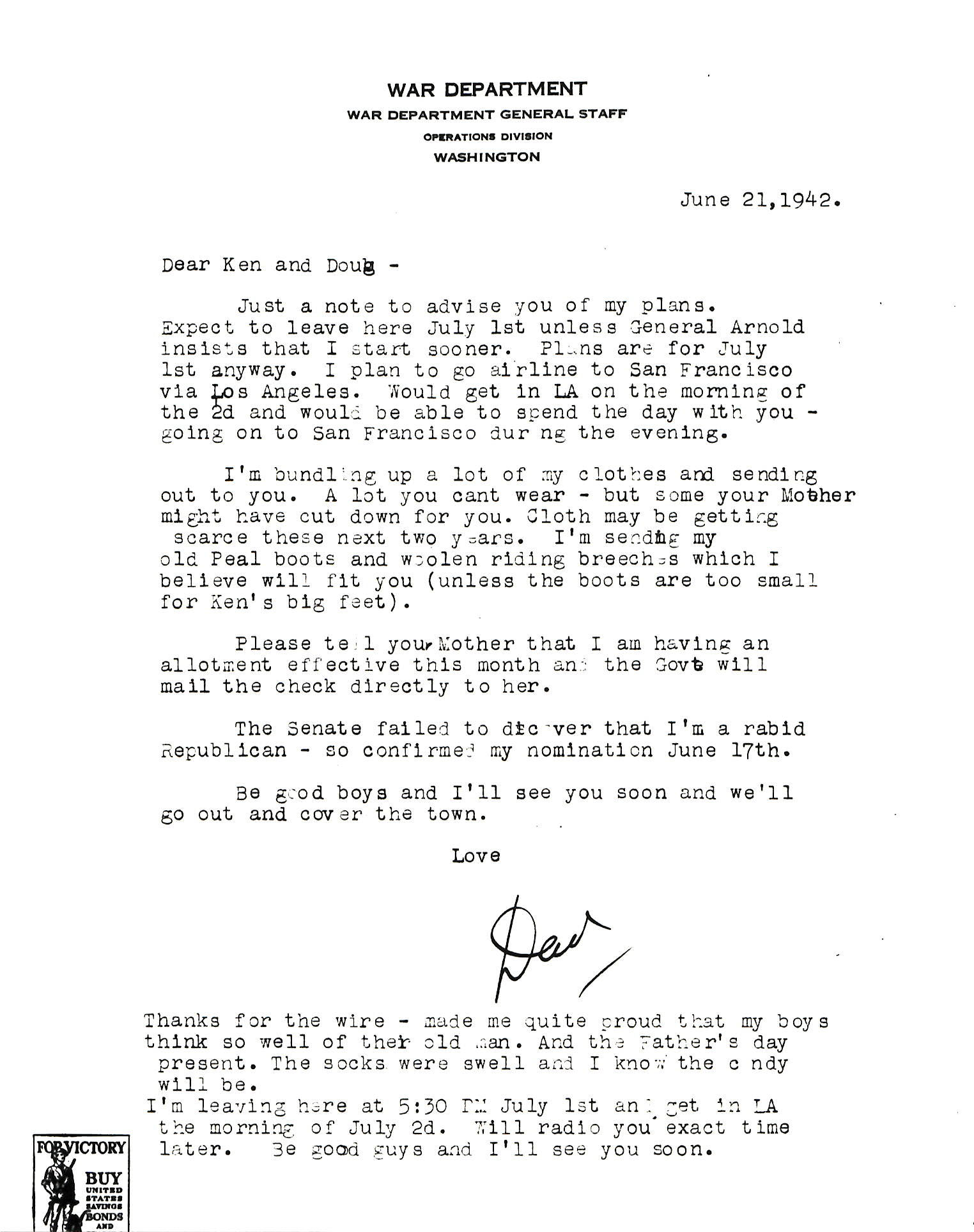
Letter to Ken Jr. and Doug, June 21, 1942
Ken Walker was a pioneer in the practical application of airpower – a zealot in the prosecution of the bomber offensive. His whole professional life was devoted to that concept.
Maj. Gen. Haywood S. “Possum” Hansell Jr., USAF, retired
General Walker’s last assignment
Commanding General, V Bomber Command, 5th Air Force
Port Moresby, Papua New Guinea

Walker (center) replaced Maj. Gen. Ralph Royce (right), Daedalian Founder Member #187, as commanding general. Photo taken in Townsville, Queensland, Australia, 1942.

Walker and his aide, Capt. Fred Dollenberg.

Walker visits the 19th Bomb Group at Mareeba, Queensland, Australia.

An invitation from the Royal Australian Air Force.

A toast with Air Commodore William “Bill” Henry Garing.

Walker (center, wearing aviator shades) visits the 3rd Bombardment Group and takes a photo with Col. John “Big Jim” Davies (fourth from right) and Maj. Gen. Ralph Royce (third from right).
National Defense is not the responsibility alone, of an Army, a Navy, or yet of an Air Force. It is the mission of the combined forces, in which each must play its part.
Brig. Gen. Kenneth N. Walker

Walker salutes Gen. Douglas MacArthur, Supreme Commander, Southwest Pacific Area, as he deplanes. On the right is Maj. Gen. George Kenney, commanding general of the Allied Air Forces and 5th Air Force, Southwest Pacific Area. Kenney was promoted to lieutenant general in October 1942.

Walker and Maj. Gen. George Kenney, commanding general of the Allied Air Forces and 5th Air Force, Southwest Pacific Area. Kenney was Daedalian Founder Member #131.

Walker can be seen in the background of this screen grab from a video about Gen. Douglas MacArthur.

Walker (right) stands with Allied leaders in New Guinea in 1942. From left are Gen. Douglas MacArthur, Field Marshal Sir Thomas Albert Blamey, Maj. Gen. George Kenney, Maj. Gen. Cyril Albert Clowes, and Walker.

Walker (right) attends a briefing in Townsville, Queensland, Australia, with Lt. Gen. Henry H. “Hap” Arnold and Brig. Gen. Ennis Whitehead.
Unless we create an adequate and separate Air Force, this next war will begin in the air and end in the mud – in the mud and debris of the demolished industries that have brought us to our knees.
Brig. Gen. Kenneth N. Walker


The V Bomber Command headquarters staff at Port Moresby, Papua New Guinea, in 1942. Walker can be seen standing right of center, wearing aviator shades.

Walker in the chow line in New Guinea.
He climbs through the bomb bay and watches the rear gunner or the side gunners blast at Zeros and when we are over the target he watches the bombardier as he gets set to drop his bombs. Wandering all over a plane like that isn’t healthy, but the general figures he can’t tell the boys how to go out and to get shot at unless he’s willing to get shot at, too.
Capt. Fred P. Dollenberg Aide to General Walker
The mission to Rabaul

The B-17F, “San Antonio Rose.”


Excerpt from Page 30, from the book, “Wings of Valor, Volume II: World War II — at War in the Pacific (1941-1943),” by C. Douglas Sterner. Available HERE through Amazon.
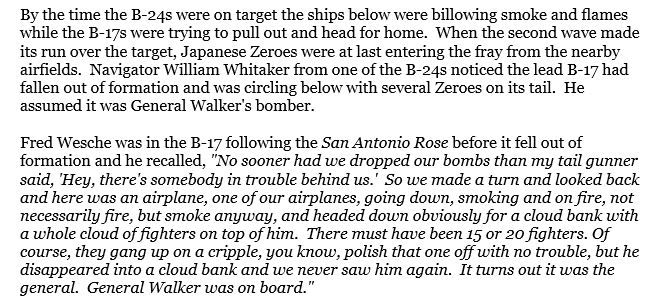


The Missing Aircrew Report.

An article in the Seattle Times.

A letter of sympathy and encouragement from Lt. Gen. George C. Kenney to Kenneth Walker Jr.

General Walker’s medals.

The press release announcing the Medal of Honor.

The page from President Franklin D. Roosevelt’s daybook with the Medal of Honor ceremony noted for 11:30 a.m. on Thursday, March 25, 1943.

General Walker’s Medal of Honor citation.

FDR hands Kenneth Walker Jr. his father’s Medal of Honor.
Walker AFB, New Mexico
Walker AFB, located three miles south of Roswell, New Mexico, was opened in 1941 as an Army Air Corps flying school and was active during World War II and the postwar era as Roswell Army Air Field. During the early years of the Cold War, it became the largest base in Strategic Air Command. The base was renamed in General Walker’s memory on Jan. 13, 1948. It closed in 1967.


Your Father was a very special man in my life. I say that because he made things right for the enlisted men…
General Walker’s son, Douglas Walker, met Frank Hohmann through the 43rd Bombardment Group Association. Hohmann told Douglas that he was devoted to his father, and it was a devotion shared by other enlisted men.

Click on the image to see the program from the 2001 memorial service.

Frank Hohmann (in leather bomber jacket) looks at the wreath at General Walker’s marker during a reunion of the 43rd Bombardment Group.

Click on the image to read Frank Hohmann’s recollections of General Walker.
Recollections of an airpower advocate
Click on the images below to see the PDF versions.
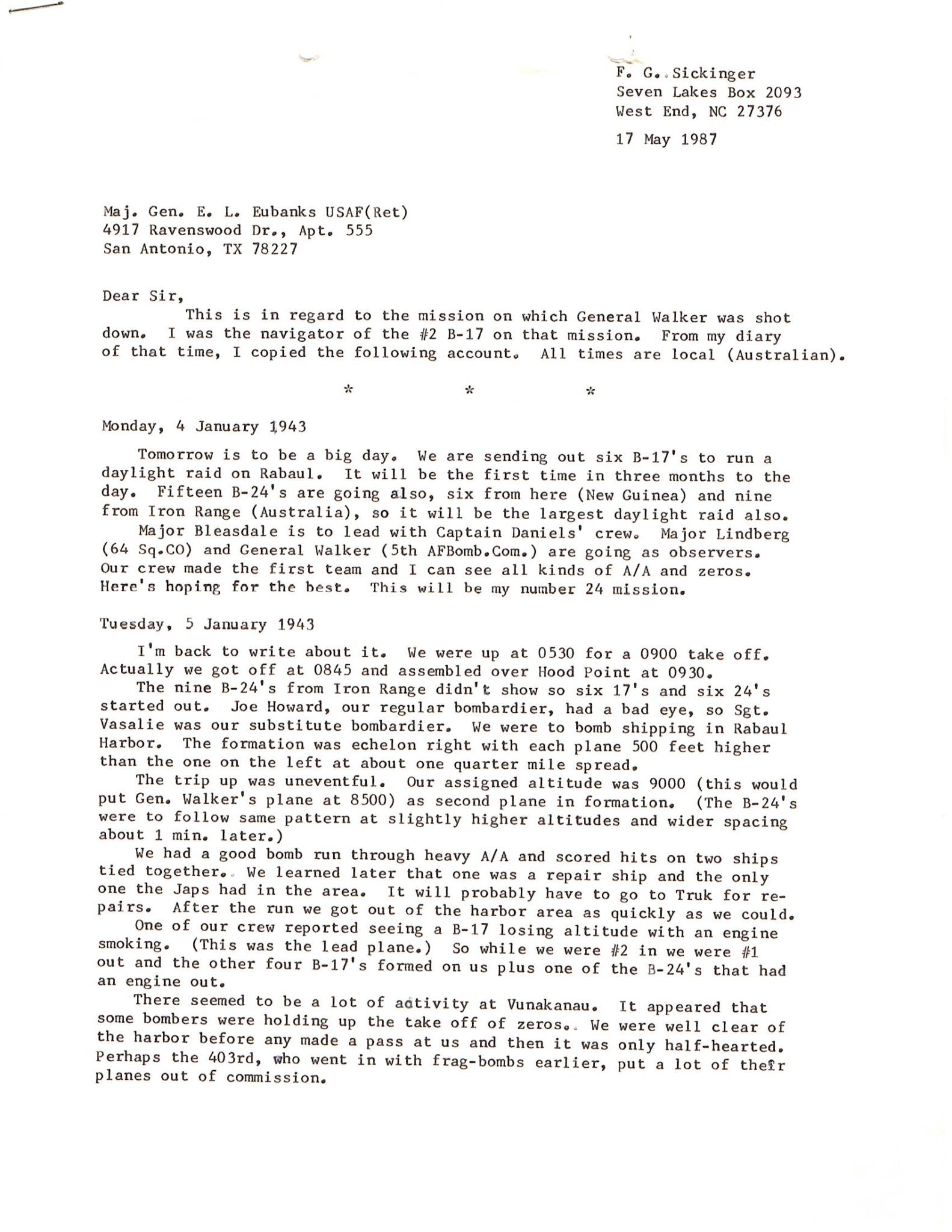
F. G. Sickinger wrote this letter in 1987 to retired Air Force Maj. Gen. Eugene L. Eubank, Daedalian Founder Member #37. Sickinger, who was the navigator of the No. 2 B-17 on the mission on which General Walker and his crew were lost, wrote his account of Jan. 5, 1943.

Retired Air Force Maj. Gen. Haywood S. Hansell Jr. wrote “Brig. Gen. Kenneth N. Walker, Prophet of Strategic Airpower” for the November 1978 issue of Air Force Magazine.

Michael John Claringbould wrote “Rabaul’s Ultimate Mystery – The Loss of Brigadier General Kenneth N. Walker” for the Fall 2002 issue of the Daedalus Flyer.
Kenneth N. Walker - Airpower’s Untempered Crusader
By Martha Byrd

Book Review by Retired Air Force Col. Francis L. Kapp
Subtitled “Airpower’s Untempered Crusader,” this is the biography of Founder Member Brig. Gen. Kenneth N. Walker, who, very early on (1928–29), embraced the theory of the invincible bomber. He remained a vocal supporter of strategic bombers and bombing until his untimely death in 1943, while on a B-17 mission in the Pacific. He remains one of the highest ranking aviators to be lost in combat. Known by his friends as a rabid defender of strategic bombing, he was relentless in its support against Chennault and the other pursuit (fighter) enthusiasts. His major achievement was his co-authoring the War Department’s Air War Plans Division document, AWPD-1, which detailed the number of planes, men, and equipment the U.S. air forces would need to go into WWII. The thrust of that document put daylight strategic bombing to the fore, allowing the air forces to prepare the way for ground forces, and raised the possibility that a bombing campaign might render a ground campaign unnecessary. Doug Walker, General Walker’s youngest son, sent this Air University published book to our Communications Director, Annette Crawford, to add to our library, in the hope it will keep the general’s story alive. If you are an airpower enthusiast, you will enjoy this book, as I did.
Click on the image at left to access a PDF version of the book. AU Press publications are available at no cost to active duty, total force, and retired military and to Department of Defense personnel and organizations. To order publications, e-mail aupress@us.af.mil or call 334-953-2773. Please note, some publications are only available in electronic format.

Click on the image to read “The Search for General Walker: New Insights” by Richard L. Dunn, published in the Fall 2014 edition of Air Power History. The article can be found on Pages 6–19.

Click on the image to read “Courage and Conviction” by John L. Frisbee, published in the October 1990 edition of Air Force Magazine.
Learn more at the official Kenneth N. Walker website: https://www.kennethnwalker.org/
If you care to comment about this web page dedicated to General Walker, or have a story you’d like to share about him, please send an email to communications@daedalians.org.